Followers

Friday, January 7, 2022

Get in the Closet!


woman-bible-hands


Whatever happened to the prayer closet? If you’ve never heard of one, it’s simply a private place to spend time with the Lord.  It can literally be a closet, a private room, or even a chair in the corner of your bedroom. Mine is a stuffed chair in my home office. It’s a place to get alone with the Lord in prayer.

Scripture records the Lord Jesus getting away for solitary prayer:

“Before daybreak the next morning, Jesus got up and went out to an isolated place to pray.” Mark 1:35 (NLT)

This is so important that Jesus tells us,

“But thou, when thou prayest, enter into thy closet, and when thou hast shut thy door, pray to thy Father which is in secret; and thy Father which seeth in secret shall reward thee openly.” Matthew 6:6 (KJV)

Then three verses later He teaches us how to pray in our prayer closet:

“After this manner therefore pray ye: Our Father which art in heaven, Hallowed be thy name. Thy kingdom come, Thy will be done in earth, as it is in heaven. Give us this day our daily bread. And forgive us our debts, as we forgive our debtors. And lead us not into temptation, but deliver us from evil: For thine is the kingdom, and the power, and the glory, forever. Amen.” Matthew 6:9-13 (KJV)

We call this the Lord’s Prayer, which describes a daily intimate personal relationship with our Father. As you enter your prayer closet, seek the Lord and allow Him to speak to your heart. This will become a habit that you’ll love, and your relationship with God will become personal and powerful. This will quickly become the best part of your day.

Now don’t just go into your prayer closet and ask for this and that. Many of us have made our prayer closet a supply closet. We only go in there for things. We don’t go in there for a relationship with God. Instead of seeking Him, we seek things! We have built shelves in our prayer closets, making it difficult to get inside. So we simply reach in and get what we want. It’s time that we believers take the shelving out of our supply closets and make them our prayer closets again.

We should make it a place where we go in, put our body down and fellowship in the Spirit with the Lord. In the prayer closet, we should give ourselves to Him and learn to enjoy the presence of the Lord. This is what He wants. This pleases our Father.

“But seek ye first the kingdom of God, and his righteousness; and all these things shall be added unto you.” Matthew 6:33 (KJV)

When we seek His presence, He sees our need and gives us His presents.

Our Father knows what we need before we even ask, even if we don’t ask. But what does He need? Us! Don’t miss out on the best part of spiritual life, which is being with the Lord. So make a little time, move those shelves, and get in the closet!

Thursday, January 6, 2022

The Illusion of Control

 God is in control. | Tweety bird quotes, Tweety, Bird quotes


“Will anyone miss me? If you have ever felt like that, then you can relate to Hagar’s heartbreak. After Hagar is used by Abraham and Sarah to conceive a son, it doesn’t take long before conflict arises. One day, it went too far. In response to Hagar’s disrespect, “Then Sarai treated Hagar so harshly that she finally ran away.” (Genesis 16:6 NLT)

Poor Hagar. Taken into a man’s chamber, but never into his heart; released by her mistress, but never set free. When Hagar realized her attempt to gain the upper hand did not work, she ran away. I imagine that Hagar never felt so alone. Perhaps she ran away thinking, “No one will miss me.” Or, “If I run away, then they’ll miss me.”

When Hagar was treated as chattel, she reacted with contempt. When Sarah was treated with contempt, she responded by bullying. When Hagar was bullied, she ran away. Just as in the Garden of Eden, all the enemy needs is one person to take the first bite to set in motion a tragic chain reaction.

For Hagar, running away likely offered her the temporary illusion of being in control. Even if she did not know where she was going, at least she could feel she was the one deciding which direction to take. It is not difficult to sympathize with Hagar’s identity crisis. She was likely acquired by Sarah at a young age. By now, her homeland is a distant memory, along with its pagan gods. She has no real relationship with the father of her child, and her mistress would probably love for Hagar to simply disappear. With no real home of her own, it is no surprise that Hagar does not know how to fully answer the Angel of the Lord’s question in Genesis 16:8, “…Where have you come from and where are you going?” (Genesis 16:8a ESV)

While God does not always call us to an easy road, His ways can always be trusted. Despite how Hagar may have felt, Scripture assures us that she was never alone. God not only saw Hagar in her affliction, but He comforted her with an amazing promise. “The angel of the Lord also said to her, ‘I will surely multiply your offspring so that they cannot be numbered for multitude.’” (Genesis 16:10 ESV)

Hagar is the only woman in the Bible to whom God personally promised a multitude of offspring. Whereas Sarah will certainly be blessed with similar and more far-reaching promises, God bestows upon Hagar His personal blessing of “a multitude” that cannot be counted. Hagar is also the only person in the entire Bible to give God a name, “You are the God who sees me” (Gen. 16:13 NIV).

How precious! In the midst of the wilderness and her woundedness, Hagar discovered she was known and she was loved. Her encounter with God gave her the courage to surrender control, obey His command, and return to her mistress – but she did not return the same. She had a voice. And she had a place. While she would remain the servant of Sarah, Hagar would also be known as the mother of Abraham’s son, whom God Himself gave the tender name Ishmael, meaning, “God hears” (Genesis 16:11). One minute we see an oppressed runaway slave; the next minute, we see a bold and courageous servant of God. No one can encounter the living God and remain unchanged.

Throughout our lives, you and I will face challenges whereby we are tempted to go our own way. It may seem like we are in control, but the reality is that control is an illusion. We are all dependent on God for everything; even our very breath comes from Him (Genesis 2:7). The truth is that when you and I resist God’s sovereignty, we hinder our own ability to experience His peace – the very thing our hearts long for the most. But praise God that He does not leave us in the midst of the wilderness and our woundedness – but willingly pursues us there!

“Where shall I go from your Spirit? Or where shall I flee from your presence?” (Psalm 139:7 ESV)

How about you? Are there any areas in your life where you struggle for control? How can your perception of being able to take care of your problems yourself lessen your awareness of your dependence on God?

Wednesday, January 5, 2022

In a Hurry and Running Late


woman-late-watch_SI.jpg


As a newlywed attending a Christian college in Southern California, I was a driver for a private mail and parcel service. Every day, I was in posh high-rise office buildings and run-down strip malls, machine shops and Mom-and-Pop shops. By the time I worked there for a year, I’d been in almost every post office in Orange County.

One day, my boss asked me to come in early because we had a new corporate client in Newport Beach who requested an early pick-up and delivery. Before heading out, I checked my map. Traffic was heavy. I was in a hurry and running late.

When I got to the post office, I turned into the drive, only to discover that I was in a long, narrow, one-way exit lane with a big red sign announcing DO NOT ENTER. The situation demanded a fast decision. Do I back up into traffic and go around the block, looking for the entrance? Or do I step on the gas and zip into the parking lot before anyone tries to exit? I pressed the pedal to the metal.

When I was almost out of the wrong-way lane, a car turned into the driveway. We both slammed on the brakes, barely avoiding a head-on collision. A bit shaken by the near-miss, I pulled up to the loading dock and put my mail onto a cart. But before I walked into the rear door of the post office, that same car sped around the building and screeched to a halt. Dressed in an expensive business suit, the driver got out and stomped towards me.

Instantly, Matthew 5:25 came to mind, “Make peace with your adversary while you’re still on your way.”

As the stranger approached, I walked up to him and said. “Sir, I owe you an apology. In a hurry, I drove into the exit. I was wrong, and would like to ask for your forgiveness.”

“Do you know who I am?” he demanded.

“No, sir. I just know that what I did was wrong. I nearly caused an accident, and I am sorry.”

“I am the postmaster,” his face a deep red by now. “I could ban you from every post office in the county. I could have the police ticket you for driving the wrong way. I could call your boss and have you fired.” When he paused, we stared nose to nose. “But tell you what. Because you admitted your wrongdoing without even knowing who I was, I will forgive you. Don’t let it happen again.”

I stood there stunned. If the Holy Spirit didn’t bring that verse to my mind at that instant, I would be in big trouble. If I let pride keep me from admitting my mistake, I might be unemployed by the end of the day.

It dawned on me that I really can trust the Scripture when it says, “don’t worry about how to defend yourself, for the Holy Spirit will tell you what to say” (Matthew 10:19-20, paraphrased). I had memorized those verses long before that morning, never realizing that I’d need to use them in a tight situation. Before driving away, I took a minute to thank the Lord for His Word and His Spirit.

After completing my route, I parked the van and took the keys to the office. While I filled out the timesheet, my boss walked in and said, “Hey, just wanted to let you know that the Newport Beach postmaster called to tell me he met you this morning.”

I froze.

“He said he was really impressed with you, and that you do good work. I Just wanted to pass that compliment on. Good job.”

Embarrassed, humbled, and relieved, I drove to the college. I was in a hurry and running late, barely getting there in time for class, but careful to obey every traffic sign.

Tuesday, January 4, 2022

Is That Your Final Answer?


Many of you will recognize the title of this article as the tagline from the game show, Who Wants to Be a Millionaire? Contestants sit in a seat opposite the host and answer multiple-choice questions in increasing difficulty, but also in increasing value up to the final one million dollar question. As they answer the questions the host asks, “Is that your final answer?” to which the player must respond that it is their final answer in order to “lock it in.” Only then will the show proceed to find out if the answer was the correct one or not.

The contestant must lock in an answer, even in the cases when they don’t know the answer. Who knows, they might get lucky and actually pick the right one? In such cases, they get to continue to play for even more money. However, life certainly isn’t like that. GOD certainly isn’t like that. Living for the Lord is a walk of faith that, on occasion, demands we declare we don’t know the answer, yet proceed anyway.

The story of Abraham underscores this tremendous truth. In Genesis 12:1-3 we find the call of Abraham and it starts like this:

“The LORD had said to Abram, “Leave your native country, your relatives, and your father’s family, and go to the land that I will show you.” Genesis 12:1 (NLT)

As the call continues, the Lord promises Abram to make a great nation out of him – a nation that will bless the world.

Genesis 12:4 tells us that Abram obeyed the Lord and moved his family. Obviously, the Lord led Abram to the land of Canaan, but often we neglect to delve into the true act of faith required to make that move. Imagine telling not only your immediate family but your extended family that you are moving. They all come over and help you pack up your moving camels (trucks of Abram’s day) and keep asking you where you are moving to. Your only response, “I don’t know.” Abram had no idea where he was going, only a sense of the Lord’s leading and that when Abram got there, God would tell him; “To a land which I will show you.”

In His famous “Don’t worry” teaching from the Sermon on the Mount in Matthew 6, Jesus told us not to be concerned over the affairs of life:

“That is why I tell you not to worry about everyday life—whether you have enough food and drink, or enough clothes to wear. Isn’t life more than food, and your body more than clothing? Matthew 6:25 (NLT)

“So don’t worry about these things, saying, `What will we eat? What will we drink? What will we wear?’ These things dominate the thoughts of unbelievers, but your heavenly Father already knows all your needs. Seek the Kingdom of God above all else, and live righteously, and he will give you everything you need.” Matthew 6:31-33 (NLT)

“I don’t know” is a legitimate answer, and often it is the answer required by those who live by faith. Where are you going? What are you going to do when you get there? How will you live? How will you pay your bills? I don’t know, I DON’T KNOW, I DON’T KNOW! But I know this, God knows! The fact that God knows, in the end, is the only thing that really matters. As He leads, He provides because He is a good father.

We like to put on the false front that we have it all together and have the answers for everything. It gets uncomfortable and we feel silly telling people that we don’t know the answers to their questions. Pretending that we know it all will rob us of our faith. We don’t live trusting in luck, we live trusting in God. It is okay to not know. So, the next time someone asks the tough questions of faith and how things are going to work out, for which there is no definitive answer, look them straight in the eye and tell them, “I don’t know, but God knows, and that’s my final answer.”

Monday, January 3, 2022

Welcoming Closed Doors


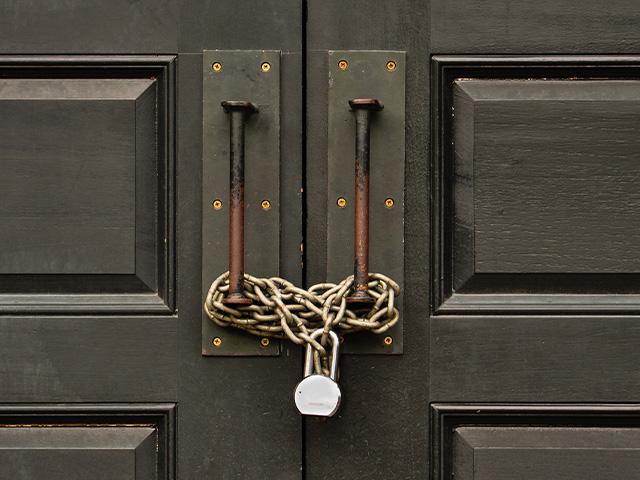
double doors closed and padlocked


We’ve all faced one. Expecting our desired result, we’ve grasped the handle of the highly anticipated door to our dreams and turned it. Expecting we’d hear the click of release, yet the latch stayed silent and we bumped against an unyielding door.

The closed door. Barring us from personal desires while our shoulder’s thud failed to assist. The moment invites a choice with deep results. Such disappointment can drive a wedge where one doesn’t belong.

“Then the LORD closed the door behind Noah.” (Genesis 7:16b ERV)

It’s easy to miss this miracle. When documenting the history of Noah’s life, Moses wrote something incredible. The LORD, not Noah, closed the door on the ark. Another version says He “sealed them inside.” Once all occupants were safely aboard, God closed the door. His main purpose was protection. He separated the inside from the outside and alone knew the extent of the volume of water that was coming, along with its duration. He knew the behavior of animals stampeding in fear and the curiosity of humankind when bored. Had God not passionately loved the contents of that ship, He’d have never closed the door Himself. It is a blessing to be locked in by our Heavenly Father.

But what of our desires to go somewhere or do something admirable in our lifetime? We all experience these longings as they’re intentionally placed within us. We’ve been given purpose along with chosen, innate gifts to successfully accomplish our goals. Like everything in life, focus is paramount so valuable energy isn’t wasted in the wrong direction. For you are the only one who can finish the work assigned you, therefore, it must be protected. Watch how He works.

“Paul and his friends went through Phrygia and Galatia, but the Holy Spirit would not let them preach in Asia. After they arrived in Mysia, they tried to go into Bithynia, but the Spirit of Jesus would not let them.” (Acts 16:6-7 CEV)

Given Paul and his fellow missionaries had no access to mapping services of where to share the Gospel, they were completely dependent on the Holy Spirit’s leading. Like us, they had specific callings that were orchestrated by The Almighty. He knew when and where to send His disciples so they’d be most effective, and guided them twice using closed doors. Allowing Paul to wander haphazardly would miss waiting hearts and opportunities. Earth’s evangelization carries a divine itinerary. It is a blessing to be locked out by our Heavenly Father.

Likewise, our lives and their mission are precious in the Lord’s sight. We’re needed exactly in the position He’s created for us. Other people have tried to unlock the door only we can and He’s wisely held it closed. The gifts and personalities He’s thoughtfully woven into us are designed for us alone. No one else is qualified to do what we’ve been born to do and therefore He jealously guards our spot in life.

We all carry purpose at infinitesimal levels. While we were being knitted together in our mother’s womb, God chose the specific threads He wanted represented in our lives. He delights in both our structured discovery and the unwrapping of His multiple gifts over our lifetime; which frequently includes unexpected but deeply satisfying changes within our decades.

I’m grateful my Shepherd hasn’t allowed someone else through a door meant solely for me. Because He’s not trying to stifle my dreams; just fulfill my heart’s desire with their completion.

Remember, Christ identifies Himself as the Door. So whether He closes you in or closes you out—it’s the perfect time to praise Him.

Sunday, January 2, 2022

Faith in perfection


“The Lord will perfect that which concerneth me: thy mercy, O Lord, endureth for ever: forsake not the works of thine own hands.” Psalm 138:8

Suggested Further Reading: Deuteronomy 31:1-8

There is yet another confession in the text—the Psalmist’s confession that all he has, he has from God. “Forsake not the works of thine own hands.” I will not, however, dwell upon it, but urge you who are believers to go home and cry aloud to God in prayer. Let this be a New Year’s day prayer. “Forsake not the work of thine hands. Father, forsake not thy little child, lest he die by the hand of the enemy. Shepherd, forsake not thy lamb, lest the wolves devour him. Great husbandman, forsake not thy little plant, lest the frost should nip it, and it should be destroyed. Forsake me not, O Lord now, and when I am old and grey headed, O Lord, forsake me not. Forsake me not in my joys, lest I curse God. Forsake me not in my sorrows, lest I murmur against him. Forsake me not in the day of my repentance, lest I lose the hope of pardon, and fall into despair; and forsake me not in the day of my strongest faith, lest my faith degenerate into presumption, and so I perish by my own hand.” Cry out to God, that he would not forsake you in your business, in your family; that he would not forsake you either upon your bed by night or in your business by day. And may God grant, when you and I shall come to the end of this year, we may have a good tale to tell concerning the faithfulness of God in having answered our prayers, and having fulfilled his promise.

For meditation: Do you open up every area of your life to the One who has promised never to forsake his people? Are there any aspects of your relationship with him which are not all that they should be (Malachi 1:6)?

Saturday, January 1, 2022

Where Are You?


man looking under the bed


Recently, my mother died. While I am thankful she lived to age 90, the final years of her life were filled with health issues and complications, surgeries, physical therapy rehabilitation, and pain. In the final months, dementia took over, wrapping her in a haze of befuddlement and fear.

Each day, when I entered the “memory” unit of the care facility, before I even saw my mother, I heard her pleading voice reverberate down the corridor, “Please! Please! Won’t somebody help me?” Even when I sat beside her, held her hand, and assured her of my presence, she continued to scream for help. During those difficult days, I often prayed, God, where are you? How does my mother’s suffering glorify you? When will you answer her cry for help?

When we are going through challenging times, it’s normal for us to ask, “God, where are you?” We want an immediate response to questions that sometimes have no ready answers. We question God’s timing and want to know the outcome of the situation prior to its resolution. But have you ever wondered what it’s like for God when we distance ourselves from Him?

“But the LORD God called to the man, ‘Where are you?'” Genesis 3:9 (NIV)

When Adam and Eve disobeyed God, they experienced fear for the first time. Suddenly, they understood the consequences of sin—separation from God. Prior to sin, they eagerly awaited God and enjoyed fellowship with Him in the beautiful, cool, lush garden that was their home. After disobeying, they feared God’s reaction and hid from their Creator. Even before God asked, “Where are you?” He knew His relationship with Adam and Eve had changed.

Many days, God asks me the same question, “Where are you?” Chores capture my attention. Deadlines loom. The Internet, social networking, phone conversations, or TV watching eat up valuable hours with little return. And God waits patiently, knocking on my heart’s door, asking where I am and why I haven’t spent time with Him.

“Here I am! I stand at the door and knock. If anyone hears my voice and opens the door, I will come in and eat with him, and he with me.” Revelation 3:20 (NIV)

Where are you? A good question. Where am I in my spiritual walk? Where am I in my prayer life? Where am I in Bible study? Where I am in telling others about God? Sometimes I am hiding because I’ve allowed unconfessed sin to erect a colossal barrier. Other days, I am simply lazy and undisciplined, navigating life in my own terms, seeking wisdom elsewhere, and fearing things that may never happen. Yet God waits patiently, missing special times of connection with me.

Sometimes we forget that God created us specifically for the purpose of having fellowship with Him. The word picture in Revelation 3:20 of Jesus sitting at the dinner table sharing a meal with us provides a reminder of the type of warm fellowship afforded us, if we are willing. But most often we ignore the offer of intimate friendship. God is standing by waiting to impart wisdom, encourage us, comfort and help us with problems and struggles. He misses us when we remain distant. But instead of seeking Him and looking forward to time with Him, we hide behind duties, obligations, events, activities, relationships, or self-created busyness that we consider more important or necessary. We fall into bed at night exhausted, and God is still waiting, sad that we have ignored him yet another day, quietly saying, “Here I am! Where are you?”