Followers

Wednesday, May 10, 2017

God Will Wipe Away Your Tears


Image result for pictures of women crying

From: Our Daily Bread

Read:

Lamentations 2:5-11
I have cried until the tears no longer come (Lamentations 2:11).
In 2013 Dr. Ad Vingerhoets, a social and behavioral scientist from the Netherlands, wrote a book called Why Only Humans Weep. He’s one of only a few scientists who have dedicated their lives to studying why people cry. Vingerhoets states that “tears are of extreme relevance for human nature. We cry because we need other people.”
Lamentations 2 is part of a poem written during a painful and tearful time of need—need for other people and for God. It’s about the destruction of Jerusalem, the suffering and exile of its people, and God’s anger at their sin. The prophet said that He “brought unending sorrow and tears upon beautiful Jerusalem” (Lamentations 2:5). He went on to say, “I have cried until the tears no longer come; my heart is broken. My spirit is poured out in agony as I see the desperate plight of my people” (Lamentations 2:11).
Years later, a poet also wrote about tears and the exile of Israel, but in a new light. Psalm 126 says, “When the Lord brought back his exiles to Jerusalem, it was like a dream! We were filled with laughter, and we sang for joy. And the other nations said, ‘What amazing things the Lord has done for them.’ . . . Those who plant in tears will harvest with shouts of joy. They weep as they go to plant their seed, but they sing as they return with the harvest” (Psalm 126:1-2,5-6).
Human suffering is all around us. On any given day we can read stories of profound suffering in the news. We can find it in every city. At times, it fills our own lives.
But our hope is in the same God who returned the exiles to Jerusalem. As John wrote, Jesus will someday “wipe every tear from [our] eyes, and there will be no more death or sorrow or crying or pain” (Revelation 21:4). That will be a new and glorious day.

Tuesday, May 9, 2017

Reaching Beyond Our Grasp


Image result for pictures of things just out of reach

(Pictures of things that are just out of their grasp).

From: Utmost.org

There is a difference between holding on to a principle and having a vision. A principle does not come from moral inspiration, but a vision does. People who are totally consumed with idealistic principles rarely do anything. A person’s own idea of God and His attributes may actually be used to justify and rationalize his deliberate neglect of his duty. Jonah tried to excuse his disobedience by saying to God, “…I know that You are a gracious and merciful God, slow to anger and abundant in lovingkindness, One who relents from doing harm” (Jonah 4:2). I too may have the right idea of God and His attributes, but that may be the very reason why I do not do my duty. But wherever there is vision, there is also a life of honesty and integrity, because the vision gives me the moral incentive.
Our own idealistic principles may actually lull us into ruin. Examine yourself spiritually to see if you have vision, or only principles.
Ah, but a man’s reach should exceed his grasp,
Or what’s a heaven for?
“Where there is no revelation [or prophetic vision]….” Once we lose sight of God, we begin to be reckless. We cast off certain restraints from activities we know are wrong. We set prayer aside as well and cease having God’s vision in the little things of life. We simply begin to act on our own initiative. If we are eating only out of our own hand, and doing things solely on our own initiative without expecting God to come in, we are on a downward path. We have lost the vision. Is our attitude today an attitude that flows from our vision of God? Are we expecting God to do greater things than He has ever done before? Is there a freshness and a vitality in our spiritual outlook?

Monday, May 8, 2017

The Burden Of Waitng


Image result for pictures of waiting

From: Our Daily Bread

Read: Psalm 90 | Bible in a Year: 2 Kings 4–6; Luke 24:36–53
Teach us to number our days, that we may gain a heart of wisdom. Psalm 90:12
Over the last few years, two members of my family have faced life-threatening diagnoses. For me, the hardest part of supporting them through their treatments has been the constant uncertainty. I am always desperate for a definitive word from a doctor, but things are rarely that straightforward. Instead of being given clarity, we are often asked to wait.
It’s hard to bear the burden of uncertainty, always wondering what the next test will reveal. Will we have weeks, months, years, or decades before death separates us? But regardless of disease and diagnosis, each of us will die one day—things like cancer just bring our mortality to the forefront instead of letting it hide in the recesses of our minds.
Faced with sobering reminders of our mortality, I find myself praying words that Moses once prayed. Psalm 90 tells us that though our lives are like grass that withers and fades (vv. 5–6), we have an eternal home with God (v. 1). Like Moses, we can ask God to teach us to number our days so we can make wise decisions (v. 12), and to make our brief lives fruitful by making what we do for Him count (v. 17). Ultimately, the psalm reminds us that our hope is not in a doctor’s diagnosis, but in a God who is “from everlasting to everlasting.”
How can we best spend the time we’ve been given?
We can face the reality of our own mortality because we trust in God.

Saturday, May 6, 2017

Liberty And The Standards Of Christ


Liberty and the Standards of Jesus

From: Utmost.org
A spiritually-minded person will never come to you with the demand— “Believe this and that”; a spiritually-minded person will demand that you align your life with the standards of Jesus. We are not asked to believe the Bible, but to believe the One whom the Bible reveals (see John 5:39-40). We are called to present liberty for the conscience of others, not to bring them liberty for their thoughts and opinions. And if we ourselves are free with the liberty of Christ, others will be brought into that same liberty— the liberty that comes from realizing the absolute control and authority of Jesus Christ.
Always measure your life solely by the standards of Jesus. Submit yourself to His yoke, and His alone; and always be careful never to place a yoke on others that is not of Jesus Christ. It takes God a long time to get us to stop thinking that unless everyone sees things exactly as we do, they must be wrong. That is never God’s view. There is only one true liberty— the liberty of Jesus at work in our conscience enabling us to do what is right.
Don’t get impatient with others. Remember how God dealt with you— with patience and with gentleness. But never water down the truth of God. Let it have its way and never apologize for it. Jesus said, “Go…and make disciples…” (Matthew 28:19), not, “Make converts to your own thoughts and opinions.”


Friday, May 5, 2017

Amazing Grace, Amazing Faith


Amazing Grace, Amazing Faith

From: Our Daily Journey

Read:

Matthew 8:5-13
When Jesus heard this, He was amazed (Matthew 8:10).
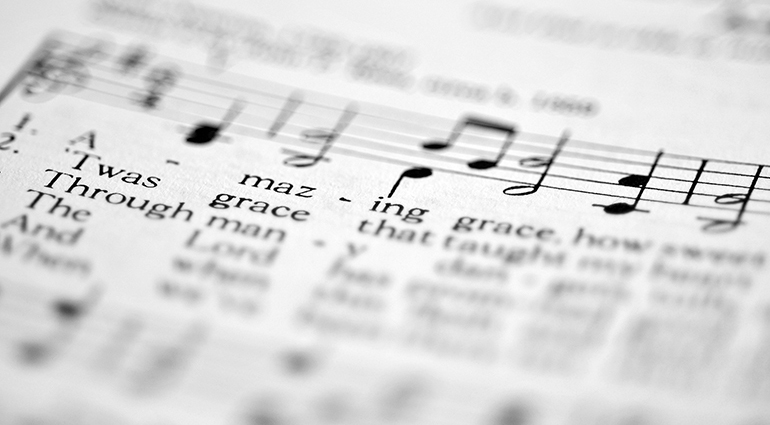
If I asked you to hum the melody of Amazing Grace, it’s likely you would know it. It’s a well-known song that reminds us about God’s astonishing forgiveness. His grace gave us spiritual sight when we were blind—allowing us to draw near to Him. God’s grace makes us shiver in reverence of Him, but it also eases our fears. As the song says, God’s grace is truly amazing!
While we marvel at the wonders of God, it’s interesting that Jesus once marveled at a person’s faith. In one instance, a Roman officer approached Jesus and explained that his servant was bedridden and in severe pain. Jesus volunteered to visit the soldier’s house and heal the man. But the centurion felt he wasn’t worthy of Jesus’ visit, and believed He could heal his servant without being present (Matthew 8:8). “When Jesus heard this, He was amazed” (Matthew 8:10). Then He commended the solider for his great faith, and confirmed that He had made the patient well.
What keeps us from amazing Jesus with our faith? Without even knowing it, we sometimes believe that the laws of nature and time limit His power. In reality, nothing could be further from the truth. Jesus is the One who created time and the scientific constants that help us understand our world. “Through [Christ] God created everything in the heavenly realms and on earth. He made the things we . . . can’t see . . . and He holds all creation together” (Colossians 1:16-17).
According to the Bible, Jesus can do whatever He wants, whenever He wants. He has the power to heal us physically and give us spiritual life. God has revealed His incredible grace through His Son (2 Timothy 1:9-10). If He’s amazed you with His grace, will you amaze Him with your faith?

Wednesday, May 3, 2017

God Is Always With Us


Alone in Space

From: Our Daily Bread

Surely the Lord is in this place, and I was not aware of it. Genesis 28:16
Apollo 15 astronaut Al Worden knew what it felt like to be on the far side of the moon. For three days back in 1971, he flew alone in his command module, Endeavor, while two crewmates worked thousands of miles below on the surface of the moon. His only companions were the stars overhead that he remembers as being so thick they seemed to wrap him in a sheet of light.
As the sun went down on the Old Testament character Jacob’s first night away from home, he too was profoundly alone, but for a different reason. He was on the run from his older brother—who wanted to kill him for stealing the family blessing normally given to the firstborn son. Yet on falling asleep, Jacob had a dream of a staircase joining heaven and earth. As he watched angels ascending and descending, he heard the voice of God promising to be with him and to bless the whole earth through his children. When Jacob woke he said, “Surely the Lord is in this place, and I was not aware of it” (Gen. 28:16).
Jacob had isolated himself because of his deceit. Yet as real as his failures, and as dark as the night, he was in the presence of the One whose plans are always better and more far-reaching than our own. Heaven is closer than we think, and the “God of Jacob” is with us.
Father, thank You for using the story of Jacob to show us that the glory of Your unseen presence and goodness is far greater than we could imagine.
God is nearer than we think.

Monday, May 1, 2017

Faith Not Emotions


Faith— Not Emotion

Faith Not Emotions
From: Utmost.org

For a while, we are fully aware of God’s concern for us. But then, when God begins to use us in His work, we begin to take on a pitiful look and talk only of our trials and difficulties. And all the while God is trying to make us do our work as hidden people who are not in the spotlight. None of us would be hidden spiritually if we could help it. Can we do our work when it seems that God has sealed up heaven? Some of us always want to be brightly illuminated saints with golden halos and with the continual glow of inspiration, and to have other saints of God dealing with us all the time. A self-assured saint is of no value to God. He is abnormal, unfit for daily life, and completely unlike God. We are here, not as immature angels, but as men and women, to do the work of this world. And we are to do it with an infinitely greater power to withstand the struggle because we have been born from above.
If we continually try to bring back those exceptional moments of inspiration, it is a sign that it is not God we want. We are becoming obsessed with the moments when God did come and speak with us, and we are insisting that He do it again. But what God wants us to do is to “walk by faith.” How many of us have set ourselves aside as if to say, “I cannot do anything else until God appears to me”? He will never do it. We will have to get up on our own, without any inspiration and without any sudden touch from God. Then comes our surprise and we find ourselves exclaiming, “Why, He was there all the time, and I never knew it!” Never live for those exceptional moments— they are surprises. God will give us His touches of inspiration only when He sees that we are not in danger of being led away by them. We must never consider our moments of inspiration as the standard way of life— our work is our standard.